Friday, June 15, 2012

The Hyperbolic Crochet Coral Reef - The Föhr Reef, contd.


Last week I have written about my experiences when starting to search for the Hyperbolic Crochet Coral Reef: The Föhr Reef  in the Föhr Museum of Art of the Western Coast during our holidays on the island. 
What I described in that first post was the status quo of Tuesday last week, when I had been to the museum and sort of acquiesced to the fact that our timing had been bad, that I was not able to participate actively in the project, and that I would not even get to see it finished. Though my husband did jokingly suggest that he and my son take the train home as planned, and I could stay a day longer to go to the opening of the show – but I knew that was a teaser, not a real or serious offer.
But on Thursday morning I met one of the women who had been at the ticket desk when I visited the museum, and we started chatting. I told her about my fascination with what fragments I had seen, and my woes of not getting to see the finished reef ‘for real’. She started praising how wonderful it looked now, just a couple of days later, when the parts had been completely assembled and the American segments had also been installed, how the excitement amongst the museum employees was rising, and that one of the initiators, Margaret Wertheim had already flown in. 
Then she told me that there would be a press conference on Friday afternoon. Perhaps I would want to try to sneak in on that? But she could not play an active part in getting me in as she would be helping out in the kitchen that day.
That’s when my heart started racing. Every once in a while I do free-lance work for our local newspaper – so in a way I am legible to be present at a press conference like that. The only problem is that I don’t hold a press identification card. Would they accept my word?
I tried to call the newsroom at home - it  was a holiday in Bavaria, nobody was working or would answer the phone. I sent an e-mail, explaining the whole situation, and asking whether they could call the museum and sign me up for the press conference. They called me back Friday morning, while my son and I were on a boat trip to the seal resting places on sandbanks off the island, saying it had all been arranged, I was being expected.

Seals resting on sandbanks during low tide in the Wadden Sea

Right after we returned from the trip to the seals, my husband took over my son, I jumped on our rental bike and headed for the museum, inbetween heavy duty rain showers. 


A wonderful ride that was and I remember thinking to myself when I got off the bike “That was sooo nice, riding here with that gorgeous light, and in anticipation of getting to see the reef!”
The museum's outside wall was now covered with the new poster announcing the exhibition.


I went into the museum, approached the font desk in a surprisingly empty room and was greeted with “how may I help you?” I introduced myself and said that I had come for the press conference and that I had been signed up by telephone only this morning. He looked at me sternly and said: “The press conference was at twelve and everything is closed off now because they are interviewing and filming. The official opening is tomorrow, you can come back then.”
Do I need to describe my feeling of disappointment? I pleaded – no, absolutely no chance to go in, the TV people did not want anybody disturbing them. I insisted – and again, and finally he conceded that he would talk to the project director when she reappeared from being interviewed. But he did not promise me anything, nor could he tell me how long I might have to wait, it might be up to two hours.
I sat down in the museum café and ordered a cup of tea. After forty minutes Ms. Heims appeared, and after more disguised pleading on my side finally agreed to give me a quick short tour of the exhibition half an hour later.
More tea, and then an interesting looking and English speaking woman appeared in the restaurant, I heard her talking to the waitress and could help out with a few translations. And then I realized who this must be and approached Margared Wertheim. 

Margaret Wertheim,
photo taken from the internet

She was very open and kindly talked to me for quite a while, telling me a lot about the whole project.
Margaret Wertheim is a physicist in training but decided to go into science journalism after finishing her first degree, instead of continuing a career in academic science. Her journalistic life has been dedicated to making the frequently difficult topics of science understandable and accessible for non-scientifically oriented people. Which was the driving force behind her foundation of the Institute for Figuring, and which was also how she came across Daina Taimina's hyperbolic crochet patterns. This was at the same time when a lot of concern was being voiced about the threats to the environment due to pollution, and about the impending mass destruction of coral reefs due to global warming. Together with her sister and a few friends “in our living room” they started making a hyperbolic crochet coral reef to raise the public’s awareness about the dangers to coral reefs, and put a note about it on their internet site. “Within a few weeks of publication of this notice, when not a whole lot had been finished yet, we received a call from the Andy Wharhol museum that they were putting together a show on artists’ responses to global warming, and would we be able to make a contribution to this show. That’s when it took off,” Margaret recalled. “We had to finish something then, and this Föhr Reef now is about the twelfth exhibition in a museum we have had.”
She is rather disappointed that the scientific world has not responded to the project at all, neither in recognition nor in funding. Instead, she has received comments such as “It’s just a bunch of women knitting.” However, the response of the art world has been overwhelming, and she hopes that a publisher will be found in the near future so that a book can be published that covers all the various aspects that are combined in the project.
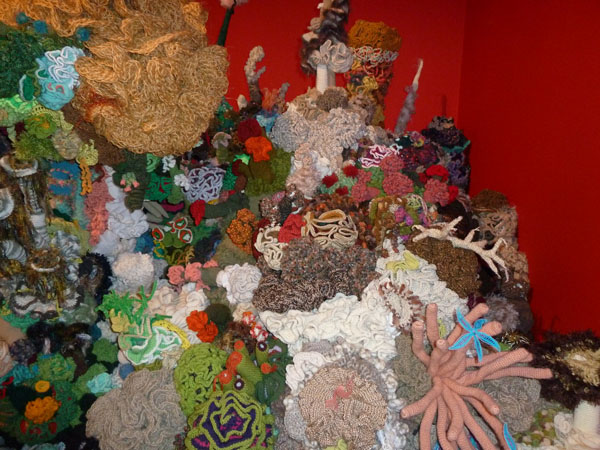
And then I did get to see the complete Föhr Reef, guided by the project director of the museum, Ms. Heims. She explained the history of the project in detail, and told me about the new feelings of community that the participating women had developed, who now want to continue their regular meetings even though the reef as such is finished. And I was allowed to take “official photos” – although my little camera was far from up to this occasion, and these photos do not nearly communicate the overall effect when one stands in the room and gets to look at the various pieces of the exhibition.
There are a few segments of the American reef, including a segment that shows “dead corals”, with crochet lace at the top which was made in China, by unnamed women who do not even know that their products have been included in this piece of art.


Another is made from beads, but also using the hyperbolic principles involved in the crochet pieces.


One segment takes up the problem of plastic refuse that pollutes the oceans in that it is made entirely from plastic rejects and junk.


The fantasy of the participating women was impressively visible in the details:


It was an overwhelming experience.
Thank you, Margaret Westheim, for talking to me about the project in such detail, and to Ms. Heims, for giving me this personal tour.

Friday, June 8, 2012

Textiles in Museums: The Hyperbolic Crochet Coral Reef - The Föhr Reef


A few days ago I posted about the museum of art on the island of Föhr, where my family and I are spending a holiday. I certainly would have gone to see the museum at some point during our stay, no matter what, even despite the limitations due to the fire earlier this year. But there was also a special point of interest that drew me there rather quickly after our arrival on the island. When we had started browsing the officially published list of activities for tourists I had noticed an entry for a “Crochet Meeting for the Coral Reef” at the museum. A special maritime kind of guerilla knitting, I wondered? An article on the children’s page of the local island newspaper brought some enlightenment:


Of course, the museum had some information (in German) on their homepage.
And then I started researching the internet.
The Föhr Reef is a satellite of the international art project „The Hyperbolic Crochet Coral Reef”  which was started by Margaret and Christine Wertheim and their Institute for Figuring, they use hyperbolic crochet forms to create large communal pieces  of art. There is a blog, too, but when I first looked before writing this, the last post had been published over a year ago .
Strangely enough, when I was about 12 years old I spent quite some time doing what they call „hyperbolic“ crochet – only I did not know that I was doing a model solution for a kind of space that even mathematicians hadn’t solved at that stage. I was just making wild skirts for my Barbies, because I wanted to be a fashion designer. Had I only known what I was doing! I might be a famous mathematician by now (except for my belief about the lack of mathematical talent...)
Anyway – hyperbolic crochet entered the art scene after Latvian mathematician DainaTaimina   had the idea of producing models of hyperbolic space in crochet. 
She has published a book on this, and there is an official book published by the Institute for Figuring.
The Föhr Museum also has a link to a German pdf-version of instructions on their homepage. 
So it turned out that our holiday was extremely ill-timed: I was too late to participate in the crochet sessions. The announcement in the list of activities was a mistake, the last session had taken place on May 20th. They were already assembling the reef. And we had timed our departure from the island, which included reservations on the overnight train, for exactly that hour when the display would be opened... So all there was left that I could do was my little research, and the visit to the museum, trying to catch a glimpse.

All over the museum’s premises you would encounter little bits of crochet coral: in the shop, outside decoration on trees, and in the museum restaurant.


On display is the official postcard of the international coral reef project:


And there is a postcard of the Föhr satellite on sale, too:


At that stage you were still allowed to look down onto the assembly area where the complete reef would ultimately be on display. They were mounting the Föhr production of crochet corals onto specially built wooden constructions which would then be integrated with several similar pieces of the international reef. Ultimately, the exhibition will travel on to other places. The guard assumed that the assembly area would closed off a few days later until the official opening, so I was lucky to catch this glimpse:


So this is a very inofficial glimpse of the possibilities. I was fascinated by the ingenuity of the makers, and the many many possibilities of turning crochet into ‘maritime art’.


During the time I was there, a group went on a tour through the museum, and while I kept trying to avoid them on most of my personal tour of the entire house, I could not escape them when standing in awe of the reef. These are approximate translations of some of the comments I heard:
  • They must have lots of money on this island if they can throw it away on stuff like this.
  • I’m too stupid to understand this kind of art.
  • This is carnival in the psychiatric institution!
  • They shouldn’t be allowed to charge any entry fee for this place at all.
  • What’s this supposed to be.
Their guide’s interesting commentary and explanations did not really reach them.
What do you think – is this art?


That's how much I got to see when I went there last Tuesday. But it's not the end of the story yet. More to follow soon.

Tuesday, June 5, 2012

Little escap(ad)e: The Museum of Art of the Western Coast


My family and I are spending a few days on the Frisian island of Föhr. Home of many emigrants to the United States - so many, that they say there are more people of Föhrean descent living in New York than on the island today. Wedged between the mainland and the island of Amrum on the Western Coast of Northern Germany, this island is my favorite place to experience the Wadden Sea at its best: water comes and goes, the wind blows, and you can’t do anything but relax.


Except visit an old church and its interesting graveyard.


And go to the beach, rent a “beach basket” to be protected from the wind, and just enjoy life.


It had been a while since I last was here, and I was more than pleased to find out that an art museum had opened in one of the island villages, Alkersum, in 2009. It is called “Museum Kunst der Westküste” (translates as "Museum of Art of the Western Coast") and collects, exhibits and researches art about the ocean and coastal regions. It was founded by Prof. h.c. Frederik Paulsen and houses his collection of art from between 1830 and 1930, which is exhibited in changing combinations in the permanent exhibition, alongside interesting contemporary exhibitions.
Unfortunately a part of the permanent exhibition – which had promised me pictures by Emil Nolde, my favorite painter -  was closed due to a fire in January. But the rest of the buildings was open, for half the usual entry fee, and a treat.


First of all, there was an impressive photo exhibition by Danish photographer Trine Sondergaard.


Her pictures of women on the Danish island Farö, wearing the traditional face masks, which were meant to protect the women’s faces from harsh weather conditions during work on the files shed a strong light on current discussions in Western countries on the head coverings of Muslim women, strangeness of customs, and our way of dealing with communication.
Secondly, there were several impressive videos by young artists, amongst them a documentation of Donna Conlon of her unpacking a set of many different plastic bags that she had collected over the years and from around the world (Más me dan, from 2005), and of ants carrying little flags and peace signs.
Unfortunately I had timed my visit so that I kept running into a group of visitors who were obviously on a bus tour around the island – and while I was quite pleased to catch some of their guide’s explanations every once in a while, I was rather annoyed by their attitude and comments about the general state of the arts and modern art in particular. “They shouldn’t be allowed to even charge this half price entry fee!” was one of the more favorable ones. Quite true, however, was the elderly lady’s “Well, I am too stupid to understand this kind of art.”
If you ever come into this part of the world, this museum is definitely a must-see!
I’ll write more about the exhibit that was my primary interest in visiting this museum in a couple of days.

Thursday, May 31, 2012

Colour of the month

22

23

24

25

26

27

28

29


30

31

Colour of the month for June: purple. (Though I have an impression that it might be rather difficult to get many pictures that are not of flowers...)

Wednesday, May 30, 2012

New in May


The month of May has brought quite a few changes in my studio. Not only did I get my new machine early in the month. (Which as of yet I have used far too little these past weeks due to my 10-day-absence for teaching and as a vendor.)
The second big change that occurred was the new sewing table, which I had ordered along with the machine from the specialized company RMF (Rauschenberger – Möbel mit Funktion): they produce furniture for sewing utensils and I finally wanted a large expanse around the amchine’s free arm, putting an end to getting stuck on the edges of the quilting table with large or even smaller quilts.
Of course, this monster of a table got delivered on the day before my departure for Karlsruhe and Einbeck, without giving us even the slightest of chances to have it installed in my studio before I left. And when I say “monster”, it is not exactly an exaggeration. My husband had insisted that I get an oversized version to avoid frustration when working on larger quilts, so this one is 1,10m deep and 1,70m wide. Which makes it huge. And heavy. And it arrived fully mounted. Somehow I was able to convince the delivery guys to bring it into the house, but they disappeared so quickly that I was not able to give them a tip – and I really think they disappeared so quickly to prevent me from even attempting to persuade them to bring it in any further than they did.
Of course, there was absolutely no time to even think about how to get it upstairs before I left, and my husband was not exactly pleased to have this huge box sitting in the living room during my prolonged absence.

unpacked, and upside down
When I called from Karlsruhe he suggested I make plans where in the living room I was going to instal my sewing machine, he saw no way how we were ever going to get that thing upstairs or through the door of my studio. Fortunately RMF was present at the event in Karlsruhe and I managed to talk to the director who gave me a few hints about how to carry it, and he also promised he would be willing to give us support via the telephone in case we really had to take it apart. “Two strong men will definitely be able to carry it upstairs,” he assured me. My husband remained sceptical, but resigned himself to ten days in the company of a huge package.
After my return from Einbeck I immediately started clearing up and out of what was my former studio arrangement. My old sewing table was scheduled to be picked up by a used furniture store two days later.


The cutting table was to be relocated, and the new sewing table was supposed to take its place, facing the wall.
Then my husband started acquainting himself with the intricacies of screws, electrical wires and how it all connected. Thanks to the telephone-hotline, he managed to take out exactly those screws that were necessary to separate the table top from the lower part.
The two of us then slowly carried the very heavy parts upstairs, separately, one step at a time. 


There is absolutely no way even three strong men would have been able to carry it upstairs fully mounted! And I assume the movers are going to think us crazy when they have to bring it back down should we really have to move...
Upstairs, the separate parts had to be put back together again. 


And we now have only one little screw left over – which my husband claims he did not open.
I did have to endure a number of slightly cynical comments about how I would have done ony my own, and what a quilter’s husband had to go through these days. But he did not let me down, and finally everything was at its new place (here the old table’s glass top is still there, being stored until pickup time):


It was left to me to do the final adjustments of the lift with which the machine can be stored beneath the table top in case you want to. Now the plane is exactly even with the machine’s free arm and quilting should be unimpeded.


Now everything is in its place. Work can resume. And big thank you goes to my helpful and supportive husband who never lets me down in taxing situations!