Showing posts with label Emil Nolde. Show all posts

Tuesday, June 26, 2012

Little escap(ad)e: Searching for Marg Moll, continued


While I was sitting in the Museum Kunst der Westküste’s café in Föhr two weeks ago, waiting for Ms Heims to return and show me around I idly leafed through some of the free art newspapers that were lying around. On the first round I did not really notice it, but on my second thoughtless turning of the pages this brief article struck my eye, stopped my breath and – apart from all that was going on while I was still trying to get to see the Föhr Reef – made my mind churn.


The sculptures which had been located in a dig in Berlin were on display in the HamburgMuseum für Kunst und Gewerbe” (Museum for Arts and Crafts) ! My search for Marg Moll, creator of the sculpture „Dancer“, which had caught my eye upon its first appearance on the front page of our newspaper one and a half years ago, had been slightly less intensive recently, but it had not left me entirely. For one thing I was planning to go to Berlin next year to meet a friend there, hoping that I would also be able to hit the museum where the sculptures were first presented after their restoration. Only as I am writing this post have I found out that a symposium was held on these sculptures in Berlin in March of this year.
  . And now this – the discovery that these sculptures were basically waiting for me right beside the path we were supposed to be following on our way home the next day. Now I felt as if I had already stretched my husband’s patience with my interest for the Hyperbolic Crochet Coral Reef – could I bring up another exhibition now? On the other hand – could I really ride past this museum and not see this particular exhibit? Certainly I would not find a chance to return to Hamburg before October, if I wanted to see it, I had to see it now. In the end I figured I would have to live without having seen this exhibit.

But that’s not how it all came to be.
Even before I had discovered that this exhibit was waiting for me, my husband and I had begun to talk about how we would spend our last day on the island/travel day. We were booked on the overnight train from Hamburg in the evening and had to vacate our apartment in the morning – should we procede to Hamburg early on and take a tour of the harbour, or visit the zoo? Add to this that the weather forecast was not exactly calling for lots of sunshine. On the day of our departure, at the breakfast table, my husband suggested that we take the opportunity and pay a brief visit to the Stiftung Ada und Emil Nolde   in Seebüll. Which turned out not easily feasible, as we soon found out. But now that my husband had made the mistake of introducing the option of another museum visit, I gathered all my courage and told him about this fantastic discovery I had made the day before. In the end, we decided that we would proceed to Hamburg directly, my husband and son would then search for an appropriate bar where they could watch the European Soccer Championship game of the day, while I would be going to the Museum.
The Museum für Kunst und Gewerbe is located directly across the street from the Hamburg main station, and they kindly do take small pieces of luggage which did not fit into lockers at the station...


It turned out to be one of the most moving art exhibits I have ever seen.
Five of the eleven sculptures that were retrieved from the excavation site in Berlin had belonged to the Museum für Kunst und Gewerbe, before the Nazis declared them “entarted” (degenerate) and removed? them from the museum and subsequently showed them in the huge propagandistic exhibition „Entartete Kunst“ (Degenerate Art) before World War II.  Several other artists who were represented in the museum fell victim to this infamous policy of the Nazis as well, and the Hamburg exhibit is built around this topic, in addition to showing the sculptures from Berlin. The names and fates of these artists are presented in addition to several of their works. A documentation shows how the sculptures were found in Berlin.


The eleven artists whose works have been unquestionable identified are presented individually.


And then, finally, the core element of the exhibition: the sculptures. All of them are indeed impressive, and their current condition, more or less badly damaged or even fragmented transforms them into monuments of a special kind.
My personal concentration on the „Dancer“ by Marg Moll is a rather subjective preference and perhaps not understandable for someone else. But when I stood in front of thise sculpture which I had first seen on the newspaper front page more than one and a half years ago, I was close to tears.


Photo documentation of the original condition of the sculpture made it possible to compare the current condition with the original. A small part is missing – the dancer’s band – and for me the current condition seemed much more impressive. Partly, of course, because of the visible damages and scars that the bronze has acquired in sixty years in soil. But also because the missing part forces the viewer to concentrate on the dancer’s position and movement, thus entering into a more intensive communication with the sculpture than had the band still been there, I thought.


A small catalogue is available which documents the Berlin section of the exhibition, Hamburg’s historic addition is unfortunately missing.


When I left the museum I was completely shaken. It hurts to think about the cultural losses that were caused by the Nazis’ infamous policy, e.g. the severy disruption of the Bauhaus style in Germany, or the restrictions of artistic development by prohibiting artists to continue working. Not to mention the lives and fates of all the people who were afflicted.
These are the names of the artists whose works were retrieved in the Berlin construction site - not all of them have an entry in Wikipedia in English, and if they do these tend to be on the brief side, therefore I give all the German links, and an English link where possible:

Otto Baum (1900-1977) 
Karl Ehlers (1904-1973) - no separate entry, only mentioned in another entry 
Richard Haizmann (1895-1963) 
Karl Knappe (1884-1970) 
KarelNiestrath (1896-1971) 
MillySteger (1881-1948), mentioned in English entry on Karl E. Osthaus 
Gustav Heinrich Wolff (1886-1934) 
Fritz Wrampe (1893-1934)  no separate entry, only mentioned in another entry 

According to a museum guide the five sculptures which had been removed from the Hamburg museum will be reconstituted after this exhibit. I assume that means that this exhibition will not travel any further, or at least not in its complete form. The guide was not certain whether this applied to all the other pieces as well. For the “Dancer”, that would mean restitution to Breslau. Who knows when I will ever get a chance to go and visit the museum there – what a lucky coincidence that I caught notice of this exhibit on our way home!

Friday, August 26, 2011

Little escap(ad)e: Ada and Emil Nolde Foundation in Seebüll


While we were vacationing at the North Sea during our summer holidays my family gave me a day off to go and see the  Ada and Emil Nolde Foundation in Seebüll near the Danish border. It is located in the house they lived in after the 1930s, and also during the years when Emil Nolde had been banned from painting by the Nazi Regime.
I had been there for the first time thirty years ago, on a bike trip taken together with two friends of mine and my brother. Ever since then Emil Nolde has remained one of my very favorite painters. I am delighted whenever I happen to come across one of his paintings in a museum. So imagine my disappointment when I stood in front of closed doors on May 1st, where an exhibition of his water colors was being shown at the Munich Pinakothek der Moderne. I think that’s when I decided that I would definitely go up to Niebüll during our summer holidays, although we would still be approximately one and a half hours drive away.
Even driving further north was sheer pleasure. The cloud formations that you get to see due to the different angle of sunlight (compared to what I am used to from the south of Germany) are phenomenal.


By coincidence I arrived at the museum on Emil Nolde’s 144th birthday and received an audio CD as a present with a radio play about Nolde and his travels.
Then I had a lot of time to explore the wonderful garden, situated at the foot of the hill upon which the house is located, overlooking the wide landscape.

Looking up at the house from the garden

Nolde-style flowers


The garden-house

Unfortunately the gorgeous display of paintings was rather crowded, so in that respect going there on a birthday might not have been the smartest idea. Though it was better to have seen it crowded than to not have seen it at all. But it was a great outing nevertheless. One would like to pick up a paintbrush and start painting oneself... though it’s probably more satisfying to look at Nolde’s work than at what I would produce.


Tuesday, February 8, 2011

Little escap(ad)e II

Sooner than I had thought I got another chance to see some art which isn’t availabe around here. Last weekend I finally went on the Christmas visit to see my parents, which had been cancelled around Christmas due to the wintery weather conditions. My son and I took the train to Karlsruhe on Friday – he is always one for train rides! – and on Saturday I arranged that grandparents and gendchild had some time to themselves. As a lucky side-effect, Mama had some time to herself, too.

So I headed for the Staatliche Kunsthalle Karlsruhe. At first I had thought I would go to see the current exhibition of Pia Fries, but as I ended up in the building with the permanent exhibition first, I decided on the spot that here I would only look at the permanent exhibition and the greenhouses of the Botanical Gardens. Which was a good decision.

In the exhibition, I was all by myself for most of the time (except for the guards), which was wonderful. I got to see some beautiful pieces by some of my all-time favorites which I hadn’t seen before: Landschaft (Haus und Kirche) from 1916 by Emil Nolde, the sculpture Panischer Schrecken by Ernst Barlach, Rehe im Walde from 1914 by Franz Marcand Leute am blauen See from 1916 by August Macke
Of course there were quite a few names new to me, amongst them Blinky Palermo 
with Himmelsrichtungen II from 1976, (here is a review of an exhibition of his works in Düsseldorf),
Palermo, Himmelrichtungen II (1976)
Imi Knoebel (the English link is not quite as informative)  with Radio Beirut from 1982 (couldn’t sneak a picture) and Ernst Buchholz (German link, English linkwith Holzbild 23 (Neue Tafeln Nr. 3) from 1923.

E. Buchholz, Holzbild 23 (Neue Tafeln Nr. 3)

A number of sculptures were also on display, and while I was impressed with the naturalness of the proportions of Gustav Seitz’s  „Die Gefesselte“ from 1949, which looked like a normal woman, not a supermodel, nor a distortion in shape, I really liked Julio Gonzales’ (German link, English link„Kaktusmensch“ from 1939/40:

J. Gonzalez, Kaktusmensch

However, I was disappointed by the first real Yves Klein which I saw here:

Y. Klein, RE 48: SOL 1960
The blue is fantastic, of course. But the piece definitely needs a thorough dusting! Probably not an aspect Klein gave mucht thought to when he decided to attach sponges and other protruding items to his pictures, but certainly an aspect that museums need to consider (though I understand, as I am not a great duster myself...).

After the paintings and sculptures I went to see the living plants in the three greenhouses, each set at a different temperature. Here I found some very nice and inspiring patterns on and with leaves.


And after the greenhouses came the real treat: the first European exhibition of works by Nancy Holt, „Sightlines“ in the Badischer Kunstverein:


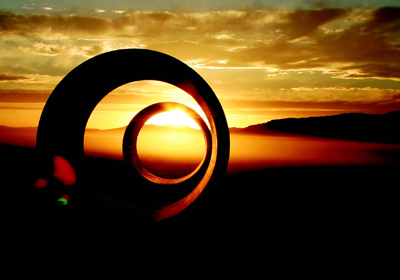
I had seen pictures of her „Sun Tunnels“ in a book on Land Art, and although I have to admit that her name had not stuck with me despite the fact that I was fascinated by the documentation on this work, I was very excited to see the photos or films of other things she has done.


A video on the construction of Sun Tunnels, with several condensed showings of the movement of light through the concrete conduits is also part of the exhibition and well worth seeing, if one can’t go to Utah in person. An extensive catalogue is due to be published any day now.

Great little escap(ad)e!