Showing posts with label conceptual art. Show all posts

Thursday, March 23, 2017

Little escap(ad)e: Guggenheim Abu Dhabi, and New York University Abu Dhabi

During my short trip to Abu Dhabi my friend and I went to see two art exhibits that were thematically related, although not planned in union, according to the curator of one of the shows. They are both on the topic of conceptual and modern art in the United Arab Emirates, looking at the movement from slightly different perspectives. According to the curator at the art museum of New York University in Abu Dhabi, she would have preferred if we had seen the exhibits in reverse order to how we did, but since neither of us really knew much about conceptual art in the U.A.E. before, it didn't really matter much, we think. The second exhibit is in the the to-be-opened Guggenheim Museum in Abu Dhabi, and we went through that with a guided tour, which was very helpful and improved our understanding considerably.


The exhibition in the Guggenheim show room focusses on aspects of performance art in the U.A.E., and the one in the NYUAD concentrates on a group of artists strongly influenced through each other, and mostly by Hassan Sharif.
I really liked many of the works on display  by Hassan Sharif, even if one might be tempted to look for influences from outside:

Hassan Sharif, Cardboard and Coir, 1999

Hassan Sharif, Plank from Directions, 2000

Photos of the performance of Directions

His influence on the art scene in U.A.E. must have been tremendous, and nowadays visitors, who have seen other, and perhaps numerous pieces of conceptual art, probably cannot understand at all the kind of effect these works must have had on their first viewers, in a part of the world that had not been overly influenced by western movements at the time.
Actually, that is one thing that I have repeatedly thought about, also in connection with music: it is hard to understand the readicality of some things on their first appearance, and the uproar they caused 'back then' when one has been living with these things all one's life. As our guided group was told in the introduction in the Guggenheim, "we have seen things like this many times, but it was radically new back then."

A favorite of mine in both exhibitions was this work by Mohamed Ahmed Ibrahim, Lines:
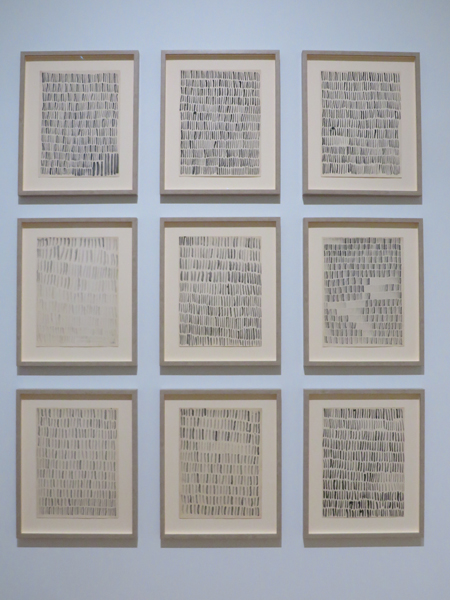
Mohamed Ahmed Ibrahim, Lines, 1992

Another of his works, Teela,


inspired my friend and me to start our very own piece of performance art on her balcony.


Whenever more sand accumulates on the balcony, my friend is going to sweep it all onto one pile, which we have started in the corner of the balcony, and covered with a piece of plastic to keep it from blowing away. We don't really know how long she is going to live in Abu Dhabi, but we hope that by the time she leaves the pile will have reached recognizable height, and will be bought by the museum for a good sum...
If you should get to Abu Dhabi soon, make sure to go and see those two exhibits. And if you would like to see performance art in the making, let me know, I will get you in touch with my friend ...

Sunday, March 17, 2013

Little escap(ad)e: Haus der Kunst, again


A few days ago a friend of mine and I took a day trip to Munich together, that also included yet another visit to the Haus der Kunst. (There are other musuems in Munich worth visiting, but somehow I often end up going there, because they have the shows that most interest me...) Of course, the Haus der Kunst in  itself is an always impressive building, outside and inside.


Outside facade with temporary installation of Jiddish words,
put up onto the Nazi-building by Mel Bochner.

Electric shift switch? Or art in itself?

Ancient organisms integrated into the building -
for the visitors to step on...
This time I went to two different exhibitions, both of which I found very impressive.
The first is an overview of Kendell Geers’ works from 1988 to 2012.  Geers is a white South-African with a working-class background, who begins his CV with the arrival of the first Dutch settlers at the Cape. His work is full of political statements, and although the catalogue claims that he has altered his original political approach to more spiritual statements after a year’s break from making art in 2000, it remains very political and provocative nevertheless.
He has used one of South Africa’s most successful export goods – double sided barbed wire – to build labyrinths for the visitor to walk through, arranges police batons in circles, spirals or other patterns, sticks broken glass into various shapes and uses as a lot of words in a variety of arrangements:

Very thought-provoking! This exhibit is still on until May 12, 2013.

The second exhibition was conceptual artist Mel Bochner’s  “Wenn die Farbe sich ändert” (“When color chages”. (His website is here and an entry in wikipedia is here). I especially liked his text-paintings. (Pictures taken from the internet.)


But also the wall with two number lines: one had been written on masking tape, starting from the left, and then pieces of the tape had been removed. This line thus was interrupted. The other number line starts from the lower right corner, running consecutively, filling in the gaps that had been left by the removed masking tape. No picture of this one...

Interestingly enough, my friend witnessed a woman photographing the Blah-Blah-picture at the entrance platform to the exhibition who insisted in her argument with the guard (who wanted her to stop taking pictures) that she had to photograph this because Bochner had stolen her idea. (Though I would say that it does not take a whole lot of originalty of idea to put a text like “blah blah” into a painting, numerous comic strips have used the sequence before...) 


And in the museum shop I found a postcard of a work by Sigmar Polke, which was similar to some of Bochner’s paintings and even the textual orientation, though at that moment I wasn’t sure which work was dated earlier than the other. But perhaps once that using text in (conceptual) art had established itself there isn’t that much stuff left to be truly original anymore?

This, too, was a very interesting exhibition, and is on until June 23.